what is a dual core processor?
A duel core processor is a CPU with two separate cores on the same die, each with its own cache.
what is multitasking?
what is multitasking
multitasking is a method where multiple tasks, also known as processes, share common processing resources such as a how do the two work together?
how do the two work together
By having multiple processors on a single server, the tasks running on the server can be divided between the processors to allow the system has a whole to function faster.
Wednesday, July 27, 2011

The CPU
1. What is the function of the CPU?
The function of the CPU is to perform operations that allow the computer to run.
2. What was the name of the first CPU?
The first microprocessor was the Intel 4004, introduced in 1971.
3.
The speed, transistors, microns, clock speed, data width and MIPS have all increase a significant amount since model 8080 to model pentium 4.
4. What does MIPS measure?
8-bit bus | ||||||
64-bit bus | ||||||
64-bit bus | ||||||
64-bit bus | ||||||
64-bit bus | ||||||
64-bit bus |
4. What does MIPS measure?
MIPS stands for "millions of instructions per second" and is a rough measure of the performance of a CPU
Tuesday, July 26, 2011
Broadband Research
1. What is broadband?
broad band is telecommunication signal which has a high data rate connection to the Internet
2. Outline the methods of delivery of broadband (wireless, cable, ADSL and fibre)? Identify the speed of each method.
wireless- The speed of the wifi connection really depends on the range of the modern to the wirless connection and how many gigabites you have when accessing the internet. (Traditional 802.11b was licensed for omnidirectional service spanning only 100–150 meters)
cable-bit rates can be as much as 400 for business connections, and 100 for residential service
ADSL- ADSL ranges from 256 kbit/s to 20 Mbit/s
fibre- fiber-optic cables connected directly to buildings will deliver broadband speeds up to 100 megabits per second.
3. Discuss the advantages and disadvantages of each method.]
wireless-
Advantages:


cable-
Advantages
- ASDL broadband is much quicker
- Another advantage is that broadband uses signals that do not disturb the normal phone signals
- Broadband is, in general, an 'always on' connection which means that it is always connected and ready to go.
Disadvantages:
- It requires a fixed physical connection between the source and destination and therefore does not support mobile applications.
ADSL-
Advantages:
- ADSL has the advantage of a dedicated amount of bandwidth, but is affected by the distance from the Central Office.
Fibre
- ItIt can cover greater distances more reliably than wire
- It can handle greater speeds, e.g. 1000Mbps and upwards
- It can not be compromised by signal tapping
Disadvantages:
- It is not as robust as wire
- It is more expensive to buy
- It is more expensive to install
- It has be installed by specialists
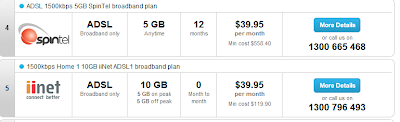
4. Give examples of broadband providers and identify the costs.
ADSL broadband ( broadband only )


12 months
- Implementation cost is cheaper than wired network.
- Ideal for the non-reachable places such as across river or mountain or rural area.
- Ideal for temporary network setups.
- Lower speed compared to wired network.
- Less secure because hacker's laptop can act as Access Point. If you connected to their laptop, they'll read all your information
- More complex to configure than wired network.
Wednesday, July 20, 2011
THE world of multimedia
1. Where do you commonly use multimedia in your daily life, list as many examples as you can.
While at home:
- ipod
- computer
- tv
- phone
In the car
- radio
- ipod
-Phone
2. What multimedia device or service would you find it hardest to be without? Discuss.
I believe that i would find it hard to live without wifi. If i didnt have wifi i wouldnt be able to connect to the web and talk to my friends ( social), and see what is happening around the world. If i didnt have wifi i would be bored and have nothing to do.
3. The video on future directions (third video) has already to some extent come true. What multimedia technologies displayed in this video are already commonly used?
The smart phone, connecting to people around the world, touch screen. voice control,
4. Do you see any advantages/disadvantages to the use of such multimedia technology?
I see a big advantage in the advance of this type of technology, this technology would enable us to do things faster and without complication.
Tuesday, June 28, 2011
FINIIISSHHHEDDD :O
FINIISHHHHEDDDD
It has been a great term, i have learned so much during this topic and i have enjoyed it so much/.
It has been a great term, i have learned so much during this topic and i have enjoyed it so much/.
Friday, June 24, 2011
Problem 101
I cannot upload my video o student net
i have tried 2 different video seize : 90 adn 30 mb
both dont work,
i have tried 2 different video seize : 90 adn 30 mb
both dont work,
Thursday, June 23, 2011
gannt chart Good copy

yellow- planning of the video
blue- doing the assessement tasks online
red= filming
green = editing
Subscribe to:
Posts (Atom)